John Terning’s View of Physics
2007
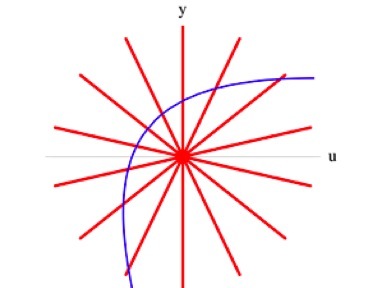
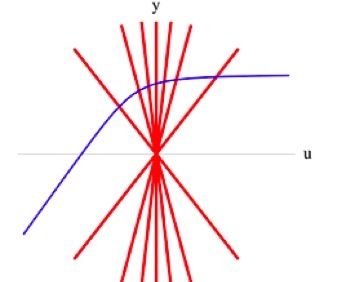
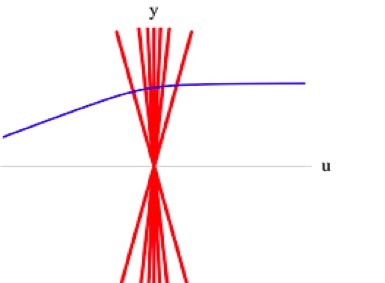
The winners of the annual Gravity Research Foundation essay competition were announced this week and the top two spots were swept by UC Davis. Steve Carlip won the $5000 first prize for his essay entitled "Symmetries, Horizons, and Black Hole Entropy", while Nemanja Kaloper and yours truly took second place with How Black Holes Form in High Energy Collisions. We looked at black hole formation following the analogous case of Coulomb scattering. Consider two charged particles colliding with one particle starting out at rest. As we increase the collision energy, the Coulomb field of the moving particle undergoes a relativistic compression, so that at velocities near the speed of light, the field lines
are compressed into a shock wave. Away from the shock wave there is essentially no scattering, everything happens as the rest particle crosses the shock wave. The same thing happens in gravitational scattering, and the shock wave metrics for a highly boosted particle are well known. If such a particle is approaching a second particle at rest, the the second particle is a tiny perturbation on the shock wave metric, so the calculation is very simple. Even if the particle at rest crosses the shock wave at a large distance from the fast-moving particle the shock wave can scatter it almost directly towards the fast-moving particle so that they can pass within the Schwarzschild radius of the particle that started at rest.
Gravitational Shockwaves
5/17/07
My view of high energy particle physics and sundry items...
PIctured left: the path of a charged particle (blue) through the stationary field lines (red) of another charged particle